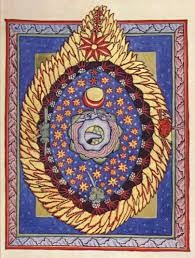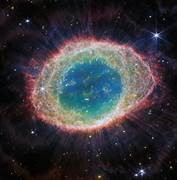
Toward the end of Jan. I had the opportunity to make a 1-day Zoom retreat on God in the Cosmos. It explored the wondrous compatibility of the visions of Hildegard of Bingen, an 11th century Benedictine mystic, the explorations of Teilhard de Chardin, a 20th century Jesuit physicist, and the 21st century astronomical findings of the space-based James Webb telescope. Considering God through these various lenses greatly increased my amazement at the ongoing nature of God’s creation. It demonstrates that God speaks to humanity in all times, spaces, and in the language of science, math, visions, and the beautiful complexity of creation itself.
Many people have heard of the Big Bang Theory. (The TV series got its name from this theory that says the universe originated with a single huge explosion in space and is still expanding.) In the 1990’s some scientists began calling this theory the Great Flowering Forth. With this re-naming they shifted the description from a mechanistic, one-time event to a that of a more complex, inter-relational growing within every created entity from a single atom to each human being. Much earlier St. Hildegard’s faith and Teilhard’s science led both of them to envision this, and in our own time images from the James Webb telescope support this new understanding of how we and the universe came into being and that this creation is still blooming.
Humans from primitive to contemporary have long tried to understand a higher power and explain the mysteries of the universe. Those who believe in a literal interpretation of the bible with its story of creation in 7 days probably consider a theory like the Big Bang or Flowering Forth to be anti-God, even heretical. Significant church officials in the times of both Hildegard and Teilhard thought this and ostracized them in significant ways. (Later both were exonerated by church officials.)
As technology and knowledge have expanded over the millennia, so has human willingness to realize that the universe is far more complex than we thought and that God’s ways are infinitely beyond our understanding. Doctors tell us that the cells of our body are constantly being replaced without our even being aware; physicists now understand that the universe is growing at this very moment, and geologists know the earth is moving thru space as you read this. While thinking about all this universal, continuous change, the concept of Lent and change of heart crept into my thinking.
Our baptism calls us to change, not physically but spiritually. If change is such an intrinsic part of our body and our universe, could awareness of this reality help us to be more humble in recognizing our personal need for interior change? If the Great Flowering Forth theory of creation contains even minimal truth, it indicates that change is an instrument God gave creation so it can become more than it already is; we ourselves can become more by deepening our life in God. How? One tool we have is the season of Lent when the church reminds us of both of our weaknesses and God’s endless mercy. Considering all this, it is comforting to believe what Teilhard said: “God is not finished with creation. Incarnation is ongoing.” Or, to paraphrase an old saying, “It’s a good thing that pencils are made with erasers.”
Hildegard envisioned creation as an egg in the womb of God. (Left) Hildegard’s vision. (Right) A James Webb image of the cosmos.