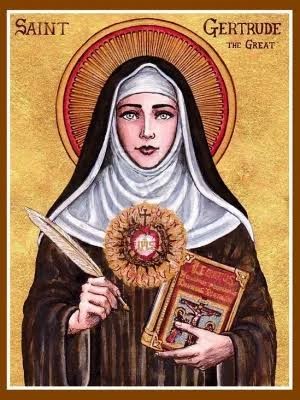
Very few. “The Great” is not an official church title, rather a popular honor indicating their major influence. Three popes, Leo, Nicholas, Gregory, plus Basil, Albert, and one woman! St. Gertrude the Great is the sole woman among this august circle.
Gertrude was born in 1256 and educated from an early age at the Benedictine Abbey of Helfta in Germany. She entered the community at age 15 or 16 and continued her education under Mechtild of Hackeborn, her teacher and friend. Gertrude was quite a scholar, excelling in a liberal arts education, which at that time included the classical disciplines of grammar, logic, rhetoric, arithmetic, geometry, music and astronomy.
In a 2010 address in St. Peter’s Square Pope Benedict XVI said of Gertrude, “…she was fascinated by knowledge and threw herself into profane studies with zeal and tenacity, achieving scholastic successes beyond every expectation.” As a novice, she was introduced to the Rule of Benedict, scripture, liturgy, patristics, and other spiritual writers of the monastic tradition. Gertrude became fluent in Latin. She studied literature, did miniature painting, and knew something of spinning and weaving.
The website of the Monastic Congregation of St. Gertrude notes that “The Helfta community did not regard Gertrude as an overly pious young woman. And Gertrude confides that she was so engrossed in her studies that she may have neglected her spiritual calling. By the time she was 24, she was beginning to find the routines of the monastery tiresome.”
Gertrude herself states: “Until the age of 25, I was a blind and insane woman, but you, Jesus, granted me the priceless familiarity of your friendship…” She dates her spiritual awakening from that time when she experienced the first of her many visions. Gertrude directed her energy and enthusiasm toward the study of scripture and theology. Well-grounded, she found in the liturgy and in scripture the images that expressed her piety. At first reluctant to write of her spiritual experiences, she was encouraged to do so by her sisters and by Christ himself. Book Two of The Herald of God’s Loving-Kindness is written in Gertrude’s own words as she witnesses to her spiritual transformation. Her Spiritual Exercises is a thematic arrangement of prayers, hymns, and reflections based on the Church’s liturgy.
Gertrude was named “The Great” by Pope Benedict XIV in the 18th c. to honor her theological and spiritual insights as perhaps the leading writer and visionary of the 13th c. monastic culture. Her feast day is celebrated on November 16.