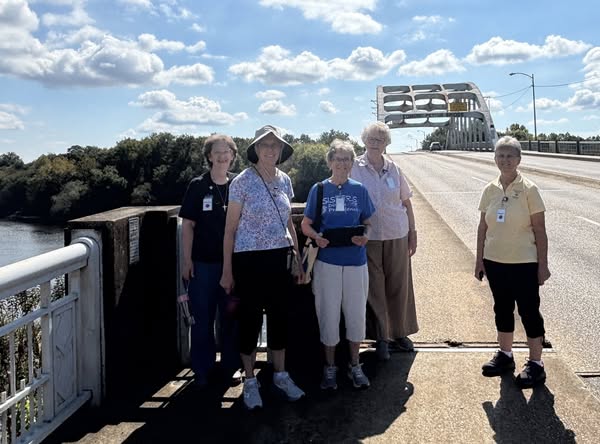
Six Catholic sisters from the Covington Diocese undertook a Civil Rights pilgrimage to Alabama, traveling by car to Selma, then to Montgomery, back to Selma and home. On October 8, 2025 Benedictine Sisters Cathy Bauer and Dorothy Schuette, Sister of Notre Dame Ruth Lubbers, Sisters of Divine Providence Jean Menke, Judy Riese and Leslie Keener set out to learn, pray and reflect on that section of our country’s history that moved the story of human rights forward as possible in that time. It is important even now as we can see the direct parallels in today’s challenges to voting rights by the gerrymandering of various states – not surprisingly those are the states which constructed the most obstacles to voting rights in the 1960s.
Our home base in Alabama was the Edmundite Missions Volunteer/Guest House in Selma. Read more about their ministry at the end of this article.
Our tour of Selma began by seeing the Boynton House. Now in disrepair, this was the home where the leaders of the movement met to plan the pivotal action that would result in congress passing the Voting Rights Act of 1965. We drove past the Dallas County Courthouse where black women and men of the time attempted to register to vote but were given “literacy” tests that were impossible to pass. Often those who attempted to vote were hunted down by the Ku Klux Klan and physically beaten.
On the morning of March 7, 1965, later called Bloody Sunday” around 600 civil rights marchers began the walk to Selma, Alabama to Montgomery—the state’s capital—in protest of Black voter suppression. As they crossed the Edmund Pettus Bridge over the Alabama River local police blocked and brutally attacked them.
Our group drove to Brown Chapel AME where the march started and we walked around the neighborhood of George Washington Carver Homes and the First Baptist Church (one of 80+ churches in Selma).
Then we drove to downtown Selma and walked across the bridge in prayer. I looked up and could see the steel girders forming the pattern of crosses, a fitting metaphor for the occasion.
At some point we drove onto the grounds of Good Samaritan Hospital – which has a bombed-out look now. It was built in 1964 by the Sisters of St. Joseph and the Edmundites. It was the only hospital serving African Americans within a six-county area, and as a result, it played a significant role in the voting rights campaign and the infamous 1965 “Bloody Sunday” march across the city’s Edmund Pettus Bridge.
After successfully fighting in court for their right to march, Dr. Martin Luther King Jr. and other civil rights leaders led two more marches and finally reached Montgomery on March 25.
August 6, 1965: President Johnson signed the Voting Rights Act of 1965 to prevent the use of literacy tests as a voting requirement.
On Saturday we drove to see the three major civil rights venues in Montgomery.
The Legacy Museum: Highlights for me included
- My feeling of being overwhelmed by the first experience: waves of the ocean as if we were in the middle with 20+ foot waves crashing around us.
- Recognizing the cruelty and indifference of slave traders and vast numbers of people affected.
- Hearing stories of individuals, seeing them as real people just like myself caught up in situations beyond their control that cause them grave harm.
Freedom Monument Sculpture Park – 17 acre outdoor park with perfect weather for us to view so many beautifully executed images of native, black and enslaved people who exuded a dignity beyond their circumstances. Freedom Monument Sculpture Park Montgomery – Search Images
National Memorial of Peace and Justice — the nation’s first comprehensive memorial dedicated to the victims of racial terror lynchings. The outdoor memorial includes tablets suspended from the roof listing the names of those lynched from each county of each state in our country.
Even as we acknowledge injustice and injuries inflicted and received by our ancestors and country-women and men, we are heartened by the care and work of our sisters and brothers to repair and build up the children of God. The Edmundite Mission where we stayed was in the heart of a neighborhood where it looked to me that at least half of the houses were burned out or damaged beyond repair for several blocks in all directions. We learned that the Edmundite Priests and Brothers were especially dedicated to working with Black families and chose not only to locate their ministries nearby, but the also chose to be buried in Serenity Cemetery open to all races. The staff, especially Sr. Mary Cashman, CDP, told us about their many programs serving “God’s people living in poverty in rural Alabama”. Among these are health clinics, financial assistance with pharmaceuticals, hot meals twice daily and food bags as needed, assistance with housing repairs and utility bills, clothing, elder-care, education and enrichment programs for youth. They are addressing the needs that people have today, but they have their eyes forward. As they state in their brochure, “Sisters Network for Youth Prosperity is an initiative of Edmundite Missions that inspire young people to believe in a future they may have thought was meant for others, not them. Our sisters go far beyond changing attitudes. We are transforming how youth see themselves, their potential, and what their futures can look like.”
Our pilgrim group’s shared prayer and reflections at the close of each day were valuable opportunities for the six of us to express our deep emotions of compassion, sorrow, solidarity and empathy for those who have been so abused in the past. We also became more aware of the traces of racial hatred that continue to exist in the society in which we live. But we are women of hope witnessing to the deepest desire of humankind to live in peace with one another.